This is exactly
what I get paid.
Every month I publish my real payslip from my job in Japan — the actual PDF from my employer, not a screenshot I made in a spreadsheet. On top of the payslip I'm handed ¥10,000 a month in cash for my bus fare, so that's counted here too. For April I've also included the bank statement, so you can see the money genuinely arriving.
—
At a glance
Where the money actually goes
Japanese payslips quote a big "gross" number, but health insurance, pension, employment insurance and income tax come out before you ever see it. Each column below is a whole month: what I keep, the bus fare paid outside the payslip, and what gets taken away.
- Take-home pay
- Bus fare (outside the payslip)
- Tax & insurance deducted
The documents
Monthly payslips
Tap any card to open the original PDF. My employer's name and my staff number are blacked out — every number is untouched. The bus fare is added underneath each card, because it never appears on the payslip itself.
Proof of payment
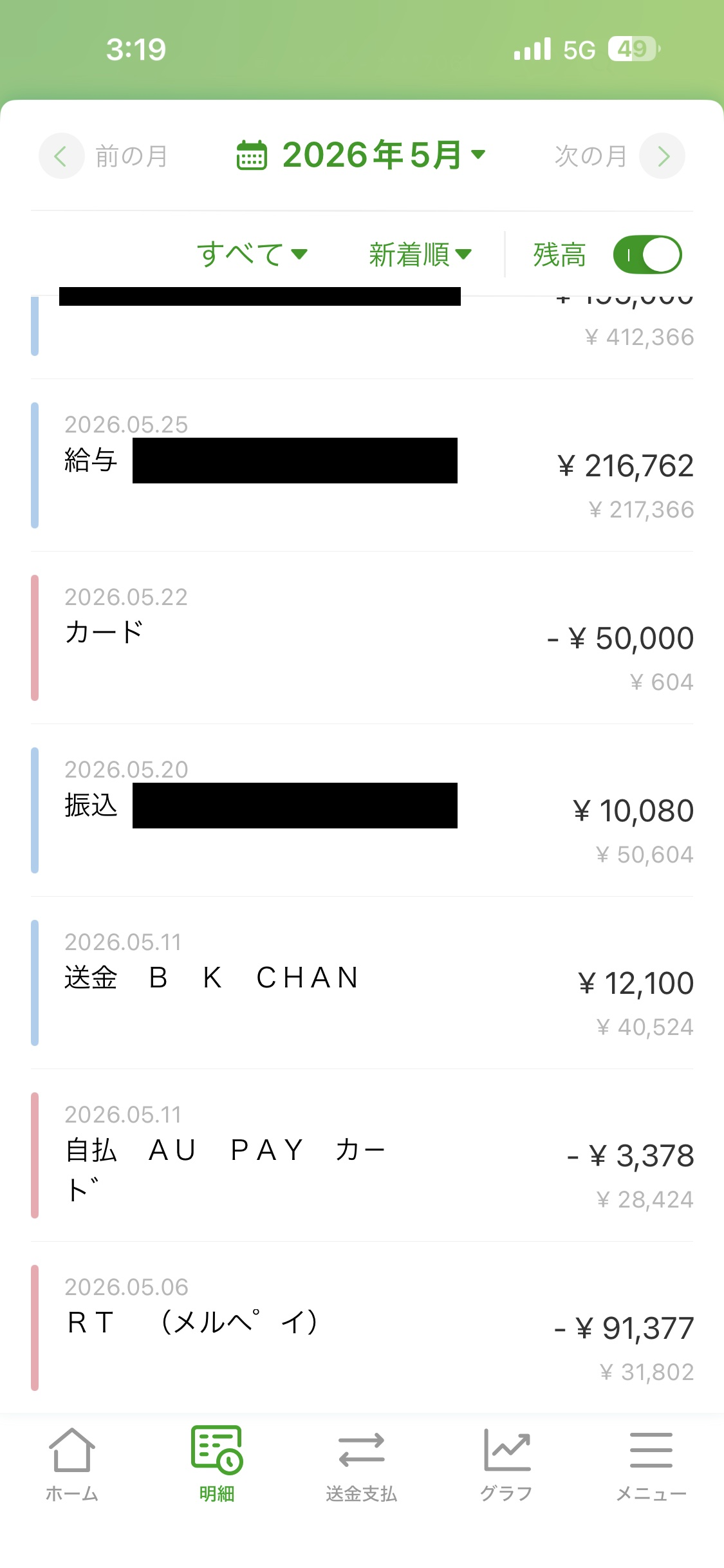
April's salary, landing in my bank
A payslip only shows what a company says it paid. This is my banking app for May 2026, where April's salary actually arrived. In Japan the month you work and the month you get paid are different — April's work is paid on 25 May.
There are two deposits to find here: the salary itself on 25 May, and the bus fare on 20 May. April was the only month the bus fare came through the bank — from May onwards it has been handed to me in cash, which is why there is no bank proof for it.
Does it match the payslip?
The salary deposit should equal the net pay line on the April payslip, to the yen. Here they are side by side.
And the second deposit?
The smaller transfer five days earlier is the bus fare. It is not on the payslip at all — it is paid on top of it.
Nothing cherry-picked
No months hidden
Every Japanese payslip prints running totals for the year (累計) at the bottom. If I'd skipped a bad month, or started earlier than I've shown, those totals would come out higher than the slips on this page add up to. Below, the totals printed on the latest payslip sit next to my own sum of every slip published here.
Line by line
Full breakdown
Every figure below is transcribed from the PDFs above, with the original Japanese label next to the English one. All amounts in Japanese yen.
Tap a month to open its full breakdown. Payslips are labelled by the month worked, not the month paid.
Before you ask
Notes & FAQ
What's blacked out?
Only my employer's name and my staff ID number. Nothing financial is hidden — every amount on every payslip is exactly as issued.
Why are April and August higher?
Both payslips carry ¥18,860 of train fare instead of the usual ¥9,430 — double the normal amount. In August that's July's missed fare being paid back. It's a reimbursement for travel costs, not extra earnings — my salary and allowance are the same every month.
What's the ¥10,000 bus fare?
On top of my payslip I get ¥10,000 every month for my bus travel. It's separate from the train fare on the payslip and it never shows up there. In April it was sent to my bank (¥10,080, visible in the statement above); since then it's been handed to me in cash.
Why is July's train fare ¥0?
The company forgot to include it that month and promised to pay it at double the usual rate on the next payslip. They did: the August payslip shows ¥18,860 of train fare, exactly 2 × ¥9,430. You can check it yourself on the August PDF.
Only 16 days in August?
August only had 16 scheduled working days (就業日数), and I worked all 16 — no absences, no paid leave used. I'm on a monthly salary, so fewer working days doesn't reduce the pay: the base salary is the same ¥220,000 as every other month.
What's the ¥276 at the bottom?
The August slip notes 健康保険内の子育て支援金 ¥276 — Japan's new child-rearing support levy. It isn't an extra deduction: it's the part of the ¥12,096 health insurance that goes to the levy, just shown separately. The health insurance amount itself hasn't changed.
Why does the month not match the pay date?
Japanese companies pay in arrears. The April payslip is paid on 25 May, May's on 25 June, and so on. The cards are labelled by the month I worked.
Is this before or after tax?
Both are shown. "Gross" is before deductions; "take-home" is what reaches my bank account after health insurance, pension, employment insurance and income tax. The cash bus fare sits on top of the take-home figure.
Where's residence tax?
Residence tax (住民税) is ¥0 on these slips. In Japan it's billed from your previous year's income, so it typically starts a year after you begin working.
Can I reuse these numbers?
Yes — quote them freely. They're published so people can see honest, verifiable figures instead of guessing what a job like mine pays.